" height="5.00155387474404px" id="T1L7vK7HI" transform="translate(4.712 7)" width="8.575800000000001px"/></svg>)
CSAT doesn't tell you the whole story
Article

Leon Jungfleisch
CEO & Co-Founder
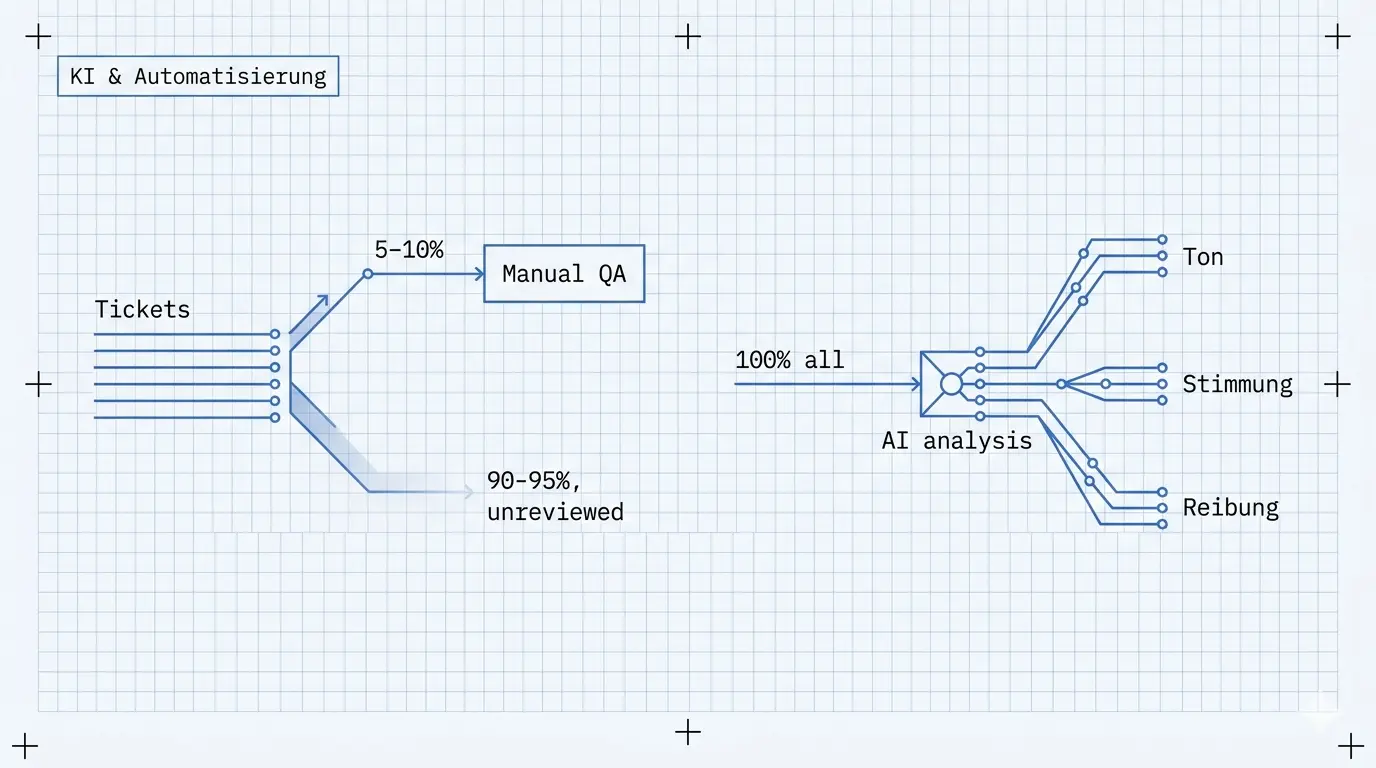
Table of Contents
A recent thread about support quality made one thing very clear: most teams only review a fraction of their conversations - and it costs them dearly. CSAT tells you when something has gone obviously wrong. But tone drift, confusing processes or friction that leaves customers quietly frustrated? Those slip through the cracks.
How teams actually monitor quality
CX leaders in the discussion shared that they usually:
Randomly review 5–10% of tickets per agent
Review every case with low CSAT, a refund or a reopening
Assess tone and accuracy separately for chat, email and voice
This combination seems methodical, but it is reactive. By the time CSAT or escalations rise, hundreds of customers have already experienced the same frustration.
Others are experimenting with full ticket analysis – they cluster tickets by sentiment drop, reason for reopening or escalation topic.
That's where the early signals appear.
What CSAT overlooks (and why that matters)
Teams reported the same invisible problems:
Low friction that never triggers a complaint
“Resolved” tickets that are not actually satisfactory
Subtle differences in long conversation threads
Recurring confusion about the same policy or the same product
Metrics that do not measure incorrect or useless answers
These do not appear in dashboards – but they cause repeat contacts and additional workload.
The operational insight
If you only review a sample, you capture symptoms, not causes.
Quality monitoring should show where customers repeatedly have difficulties, not just how an agent handled it.
Forward-looking CX leaders move from sample checking to signal detection:
Cluster similar tickets (reopenings, delays, misunderstandings) to identify friction points.
Track tone and sentiment trends at ticket level.
How themes in repeated contacts correlate with process or product changes.
This turns QA from reactive assessment into early prevention.
Where vennie comes into play
At vennie, we believe that 100% visibility should not mean 100% manual work.
Our AI analyses every conversation, detects shifts in sentiment and patterns, and flags emerging friction points – long before they become visible in CSAT or escalation data.
That’s how e-commerce teams keep their quality high as volume grows – without additional QA capacity.
Curious how that works in practice? We’d be happy to show you.