" height="5.00155387474404px" id="T1L7vK7HI" transform="translate(4.712 7)" width="8.575800000000001px"/></svg>)
Autonomous Learning: how vennie learns from small gaps
Article

Leon Jungfleisch
CEO & Co-Founder
In this article
Autonomous Learning adds a dynamic knowledge layer to fixed processes—without a new dashboard or additional day-to-day maintenance.
Why small gaps matter
Before we get to Autonomous Learning, a quick note: since 2 August 2026, new transparency obligations apply to certain AI systems that interact directly with people. More on that at the end of this article ↓
A core part of our process is Gap Mining: we continuously compare how a customer would actually answer a request with what vennie automatically suggests.
This rarely reveals large gaps. It is usually small things: minor deviations that are not particularly surprising on their own but add up over time. Those small things are exactly why we are introducing Autonomous Learning.
Why Autonomous Learning is necessary
Building a new flow is not worthwhile for every small case. Some cases are too rare, while others are too specific to a single request to justify a separate process.
Yet these are exactly the cases that add up to meaningful differences in quality. Autonomous Learning is our answer: a dynamic layer that absorbs these cases instead of requiring a dedicated flow for each one.
How the knowledge is created
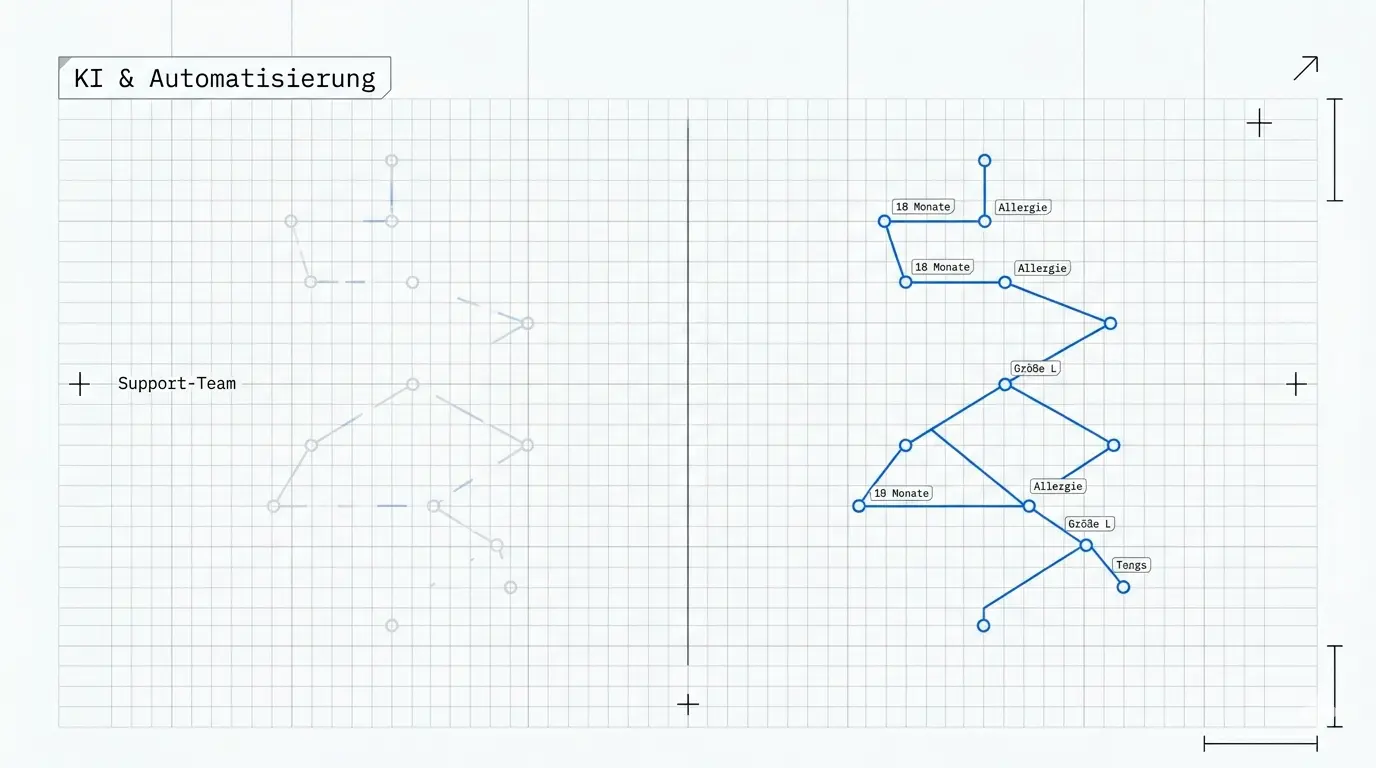
Autonomous Learning automatically creates learning notes from work that is already happening day to day—for example, from Gap Mining and Process Automation Mining.
We are continuously expanding the places where the system can pick up new information. This means the knowledge base vennie learns from keeps growing with ongoing operations.
Where learning notes are used
Once captured, a learning note feeds into several parts of the system. We are gradually building this connection into more areas of the software:
1 – For information requests, it supplies the right answer directly.
→ For example, a shop normally has a 30-day return policy on file. A temporary issue means that the goodwill period is currently 60 days. From a human reply, vennie picks up this exception and automatically includes it in future answers for as long as it applies—without anyone having to maintain a new rule.
2 – When drafting replies, small adjustments in style or wording identified through Gap Mining are incorporated automatically.
3 – For quality assurance, the system draws on past replies for comparison at both the original decision stage and the finished result. It checks whether the handling matches how your team would approach the case.
What changes for our customers
For most customers, there is nothing you need to do actively. There is no new dashboard and no extra step in your day-to-day work—you simply get better, more consistent replies.
For those who currently maintain QA Policies, the effort may even decrease. QA Policies remain the foundation but are now supplemented by Autonomous Learning.
Rollout and transparency obligations from August 2026
We are rolling out Autonomous Learning gradually. Ultimately, it will be embedded in as many parts of the software as possible. We are also making it increasingly transparent which specific actions each learning note originates from.
EU AI Act note: Since 2 August 2026, the transparency obligations in Article 50 of the EU AI Act have applied. Providers of AI systems that interact directly with people must generally design those systems so that individuals are clearly informed at the start of the first interaction that they are interacting with AI—unless this is already obvious from the context of use.
The specific responsibilities of providers and deployers depend on the setup and should be reviewed with legal counsel. This overview is not legal advice.